I study how institutional and platform rules shape access to markets, the allocation of labor and skills, and innovation. My work combines structural spatial-equilibrium and general-equilibrium models with applied microeconometrics and institutional analysis, with applications to digital markets, migration, infrastructure, and human capital.
Publications · Digital Markets, Regulation, and Innovation · Mobility and Spatial Growth · Human Capital
Publications
Why is household electricity uptake low in Sub-Saharan Africa?
With Moussa P. Blimpo and Agnieszka Postepska · World Development, 133 (2020).
Using harmonized household surveys across more than 30 Sub-Saharan African countries and qualitative fieldwork, we find that demand-side constraints account for more than two-fifths of the electricity access deficit. Income, housing quality, and community infrastructure shape adoption, highlighting the importance of complementary policies alongside grid expansion.
Technology in the Classroom and Learning in Secondary Schools
With Moussa P. Blimpo, Ousman Gajigo, Solomon Owusu, and Ryoko Tomita · World Bank Policy Research Working Paper No. 9288 (2020).
We evaluate computer-assisted learning in secondary schools in The Gambia using administrative and survey data. The program increased mathematics certification scores by 0.59 standard deviations and the share of students obtaining credit by 15 percentage points, providing evidence on technology-enabled instruction in a low-income setting.
Digital Markets, Regulation, and Innovation
From Market Opening to Innovation: Effective Contestability in Digital Markets
Working paper · September 2026.
Paper (PDF) · Supplementary presentation
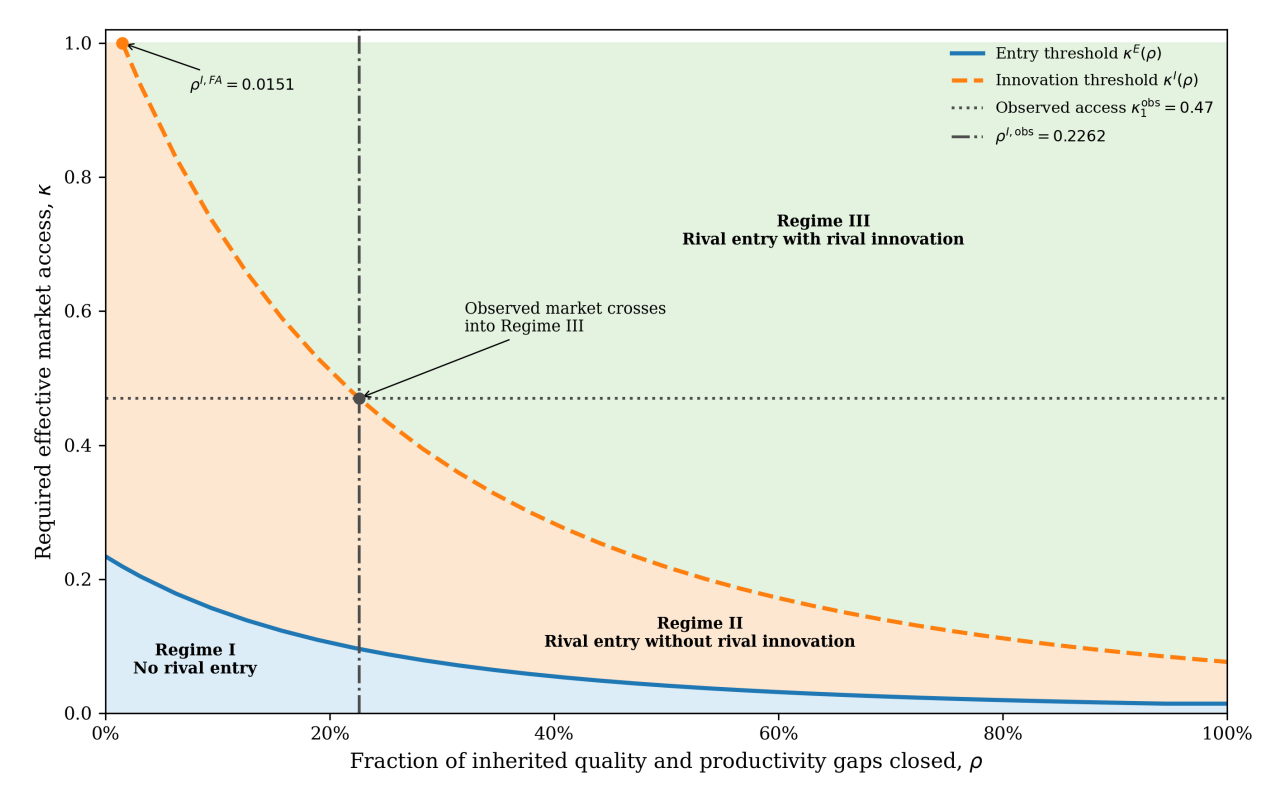
When does market opening produce an innovative competitor? A two-period stochastic general-equilibrium model separates the thresholds for rival entry and innovation. In the EU iOS app-distribution calibration, observed access supports entry, but benchmark rival innovation remains unprofitable even at full access. Stronger inherited quality and productivity or greater innovation capacity can bring innovation within reach. Platform R&D and welfare can rise even as platform profits fall.
Figure: Entry and innovation regimes — September 2026
Beyond Market Concentration: Measuring Contestability in Digital Markets
With Zhiyang Cheng and Amr Yakout · Working paper, July 2026.
Paper (PDF) · Supplementary presentation
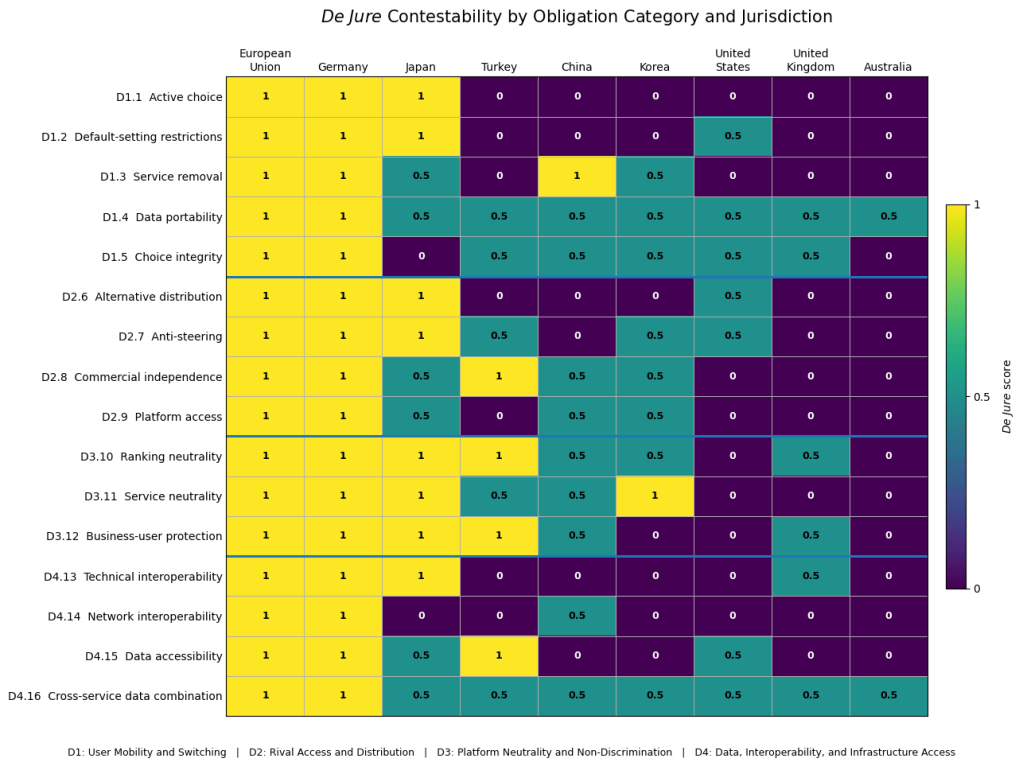
We measure competitive opportunity across four channels: user mobility, rival access and distribution, platform neutrality, and access to data, interoperability, and infrastructure. Distinguishing formal legal protections from opportunities realized in practice, the framework covers nine jurisdictions and pilot applications to search and mobile app distribution. The results reveal gaps between legal opening and effective challenge, with different barriers across markets.
Figure: De jure contestability across jurisdictions
Comments on the First Review of the Digital Markets Act
Yale Tobin Center for Economic Policy.
An assessment of early DMA implementation, focusing on contestability, compliance, and innovation incentives. The analysis connects enforcement challenges to market access, entry conditions, and the distribution of platform rents.
Blueprint for a Technical Committee in U.S. v. Google (Search)
Policy report.
This report proposes an institutional design for overseeing remedy implementation in United States v. Google LLC. Drawing on the Microsoft remedy and recent regulatory experience, it sets out technical access, authority, and monitoring procedures to address information asymmetries and support effective enforcement.
Institutional Frictions, Mobility, and Spatial Growth
Internal Migration Restrictions, Aggregate Productivity, and Spatial Growth
Job market paper.
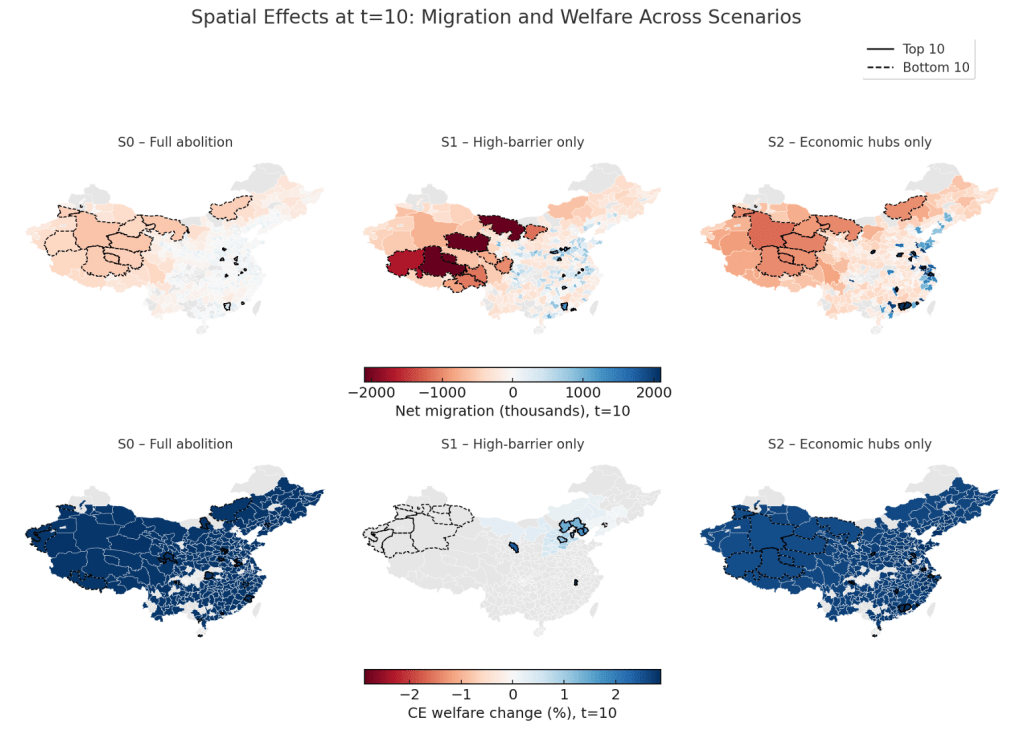
A dynamic spatial general-equilibrium model quantifies how China’s hukou restrictions shape labor allocation and aggregate productivity. The framework incorporates trade, agglomeration, endogenous amenities, and migration costs by registration status. Counterfactual reforms examine regional inequality and long-run spatial growth.
Figure: Who moves and who benefits? Simulated effects of hukou reform after 100 years
High-Speed Rail: Impacts on Mobility Costs and Spatial Reallocation
Work in progress.
This project extends my spatial framework to study how reductions in transportation costs interact with institutional migration frictions. It examines how high-speed rail changes regional specialization, labor allocation, and productivity—and how those effects depend on the migration regime.
Human Capital and Digital Transformation
Digital Skills and Labor Market Demand in Central Asia
Working paper.
Using employer surveys, wage data, and skills assessments, this project examines how digital competencies relate to employment, wage premia, and mismatch in transition economies. It documents demand for digital skills and gaps in training systems that limit workers’ adjustment to technological change.
Digital Skills for Lifelong Learning (DS4LL), Kyrgyzstan
Policy paper.
An impact evaluation across approximately 300 secondary schools combines student and teacher digital-competency assessments with implementation data. The project examines learning gains and institutional capacity to inform curriculum reform, teacher training, and technology integration.

