Overview
My research studies how institutional and technological constraints shape access to markets, economic allocation, and long-run innovation. Across contexts—including infrastructure adoption, labor mobility, education technology, and digital platform governance—I examine how frictions and regulatory design influence participation, entry, and welfare.
My work combines applied microeconomics, quantitative modeling, and institutional analysis to study how rules governing access (e.g., to electricity, mobility, skills, or digital markets) affect economic opportunity and development.
Publications
Why is household electricity uptake low in Sub-Saharan Africa? [Download]
with Moussa P. Blimpo and Agnieszka Postepska
World Development, Volume 133, 2020.
This paper investigates why electricity adoption remains low across more than 30 Sub-Saharan African countries despite substantial investments in supply-side expansion. Using harmonized household survey data combined with qualitative fieldwork, we quantify the relative importance of demand-side constraints in explaining electrification gaps. We show that demand factors account for more than two-fifths of the access deficit, highlighting the limitations of policies focused solely on grid expansion. Household income levels, income regularity, housing quality, and community infrastructure significantly influence adoption decisions. Our findings suggest that cost reduction, flexible billing schemes, and complementary income-generating opportunities are essential to improving uptake. The paper contributes to the literature on infrastructure adoption, demand-side development constraints, and access to essential services.
Technology in the Classroom and Learning in Secondary Schools. [Download]
with Moussa P. Blimpo, Ousman Gajigo, Solomon Owusu, and Ryoko Tomita
Policy Research Working Paper No. 9288. World Bank, Washington, DC. 2020.
This paper evaluates the impact of a computer-assisted learning program implemented in secondary schools in The Gambia. The program introduced technology-enhanced teaching methods in mathematics and science, aiming to improve foundational competencies and exam performance. Because participating schools were not randomly selected, we construct a credible counterfactual using administrative and survey data and implement a pre-analysis plan prior to observing high-stakes certification outcomes. Using certification exam data, we find that the program increased mathematics scores by 0.59 standard deviations and raised the share of students obtaining credit—required for college admission—by 15 percentage points. The results provide evidence on the effectiveness of technology-enabled instruction in low-income settings and contribute to the literature on human capital formation and education technology in developing economies.
Current Research
I. Institutional Frictions, Mobility, and Spatial Growth
Internal Migration Restrictions, Aggregate Productivity, and Spatial Growth [Download]
(Job Market Paper)
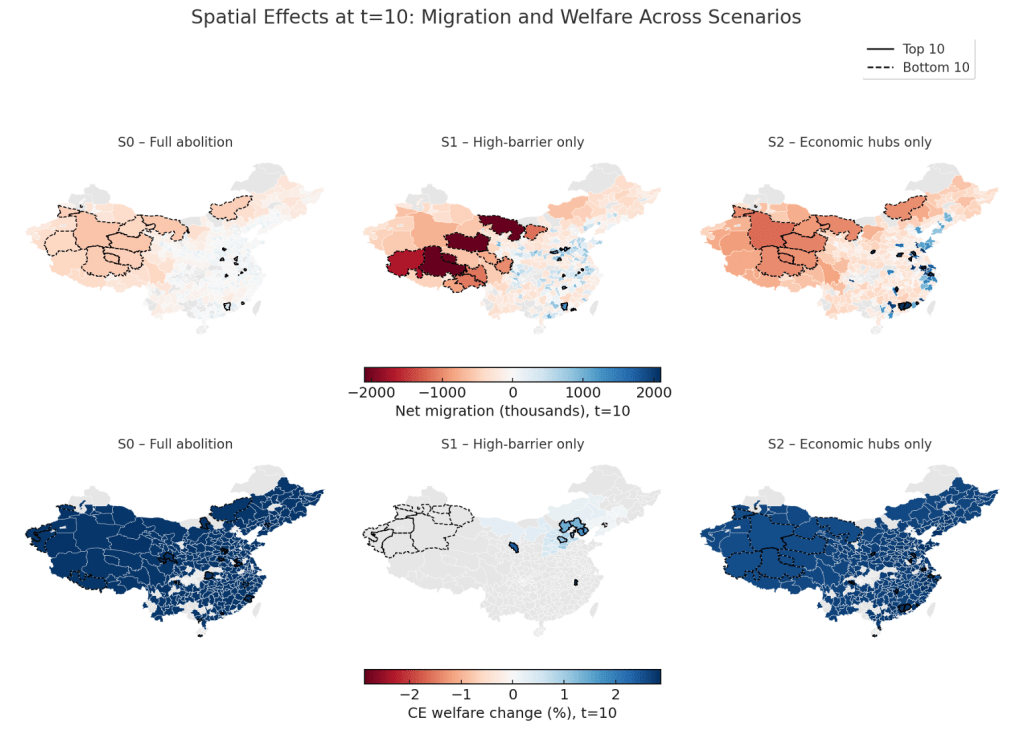
This paper develops a dynamic spatial general equilibrium model to quantify the aggregate consequences of migration restrictions under China’s hukou system. The model incorporates trade linkages, agglomeration effects, endogenous amenities, and migration costs that differ by registration status. Using prefecture-level panel data, I estimate structural parameters governing migration elasticity, productivity dynamics, and amenity formation. Counterfactual simulations evaluate how relaxing hukou restrictions would reallocate labor across regions, affect regional inequality, and influence aggregate productivity. The paper contributes to the literature on spatial misallocation, internal migration, and institutional barriers to economic efficiency, offering quantitative evidence on how mobility restrictions distort long-run growth.
Who Moves and Who Benefits? Simulated Effects of Hukou Reform After 100 Years
High-Speed Rail: Impacts on Mobility Costs and Spatial Reallocation
(Work in Progress)
This project extends my spatial framework to study how reductions in transportation costs interact with institutional migration frictions. By modeling high-speed rail expansion as a decline in trade and commuting costs, I examine how infrastructure reshapes regional specialization, labor allocation, and productivity dynamics. The analysis highlights how transportation investment can partially offset institutional barriers, but also how its effects depend critically on the underlying migration regime. The project contributes to understanding the interaction between infrastructure policy and institutional constraints in shaping spatial equilibrium outcomes.
II. Human Capital and Digital Transformation
Digital Skills and Labor Market Demand in Central Asia
(Working Paper)
This project examines the emergence of digital skills as a new dimension of labor market demand in transition economies. Using employer surveys, wage data, and skill assessments, the paper studies how digital competencies affect employment probabilities, wage premia, and mismatch patterns. The analysis documents a growing digital skill premium and identifies structural gaps in training systems that limit workers’ ability to adapt to technological change. The paper contributes to the literature on skill-biased technological change and labor market adjustment in developing and middle-income countries.
Digital Skills for Lifelong Learning (DS4LL), Kyrgyzstan
(Policy Paper)
This large-scale impact evaluation assesses the effects of digital-skills interventions across approximately 300 secondary schools. The study combines structured digital competency assessments for students and teachers with program implementation data to evaluate learning gains and institutional capacity building. The project provides evidence on how curriculum reform, teacher training, and technology integration affect digital readiness and long-term labor market preparedness. The findings inform education policy in emerging economies undergoing digital transformation.
III. Platform Governance, Contestability, and Innovation
Contestability, Innovation, and Platform Governance under the EU Digital Markets Act
(ongoing Project)
This project develops a structural framework to analyze how regulatory interventions under the EU Digital Markets Act affect market contestability and innovation incentives in digital platform markets. The model studies how restrictions on self-preferencing, interoperability requirements, and access obligations alter entry decisions, rent distribution, and dynamic investment behavior. By integrating theory with platform-level data, the project aims to quantify the welfare and innovation effects of regulatory design. The research contributes to the literature on platform competition, regulatory economics, and the interaction between enforcement architecture and market structure.
Comments on the First Review of the Digital Markets Act [Download]
(Yale Tobin Center for Economic Policy)
This policy-oriented analysis evaluates early evidence from the DMA’s implementation phase, focusing on contestability outcomes, compliance challenges, and innovation incentives. The piece connects practical enforcement developments with broader economic questions about market access, entry conditions, and the distribution of rents in platform ecosystems.
Blueprint for a Technical Committee in U.S. v. Google (Search)
(Forthcoming)
This paper proposes an institutional design for a Technical Committee to oversee remedy implementation in United States v. Google LLC. Drawing on the Microsoft remedy and recent regulatory experience, it outlines the authority, technical access, and monitoring procedures required to address information asymmetries and ensure effective enforcement in dynamic digital markets. The paper conceptualizes enforcement architecture as an economic mechanism that shapes firm incentives and the effectiveness of competition remedies.
 Yanbin